
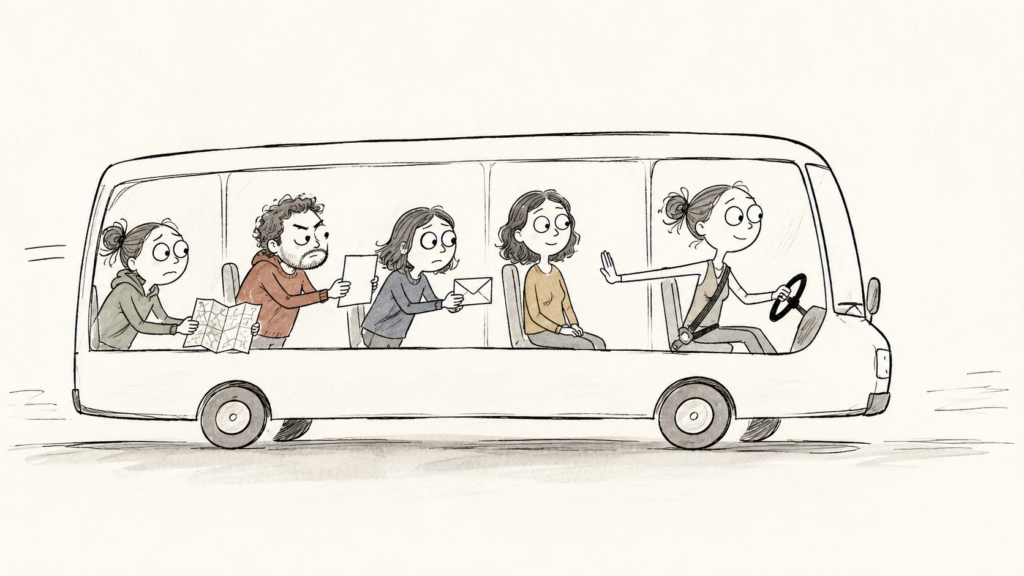
You've learned, without ever quite deciding to, that some of your feelings are welcome and others are a nuisance. The trouble is that the ones you've filed under nuisance are often the ones with the most to tell you.
Think about a relationship, romantic or otherwise, that mattered to you. Alongside the love and the warmth there was probably something else at times, a quiet heartache, a flicker of resentment, a sense that something wasn't quite right. And if you're anything like the people I tend to work with, you did what capable, conscientious people do. You noticed the good feelings and leaned into them, and you talked yourself out of the uncomfortable ones. You decided you were being unfair, or too sensitive, or ungrateful, and you tried a little harder to feel the way you thought you were supposed to.
I want to suggest that this habit, however reasonable it looks, quietly costs you. Trusting your experience isn't only about listening to the feelings you like. It's about paying attention to all of them, especially the ones you'd rather not have.
The feelings we're willing to hear
Most of us carry an unspoken sorting system for our emotions. Some are acceptable, even admirable. Gratitude, enthusiasm, calm, affection. Others feel like problems to be managed. Anger, envy, disappointment, that stubborn unease that won't give you a reason. Without ever being taught it directly, you absorbed a sense of which feelings were allowed and which ones marked you out as difficult or weak.
So you curate. You let the approved feelings through and you quietly show the others the door, and because you're good at it, you often don't notice you're doing it at all. It looks like being positive, being resilient, not making a fuss. Underneath, it's a kind of editing, and the material you keep cutting is information about your own life.
Why we silence the difficult ones
For a lot of high-functioning people, this goes deeper than habit. Somewhere along the way you learned that your worth depended on being fine, on coping, on not being the person who struggled. Difficult emotions threatened that picture, so you learned to override them, and to be quite hard on yourself for having them in the first place.
This is where self-criticism does its quiet damage. The moment an unwelcome feeling appears, a second reaction follows almost instantly, telling you that you shouldn't feel this way, that other people have it worse, that you're being irrational. That inner voice thinks it's helping you stay reasonable and grateful. What it's actually doing is teaching you to distrust your own responses, so that over time you become a stranger to a large part of what you feel. And you can't trust your experience while you're busy talking yourself out of half of it.
What the painful feelings are actually telling you
Here's the reframe I'd offer. Uncomfortable emotions are not evidence that something is wrong with you. They're information about something that matters to you.
Resentment often points at a boundary that's been crossed or a need that's gone unspoken for too long. Disappointment tells you something mattered more than you were letting yourself admit. That unease in the relationship, the one you kept overriding, may have been the most honest thing you had, quietly reporting that something needed attention long before your thinking mind was willing to look at it. Feelings tend to know before we do, and the painful ones are usually pointing at exactly the places we most need to attend to.
None of this means the feeling is the final word, and it's worth being clear about that, because I've written before that feelings are valid but not always true or helpful. Attending to a feeling is not the same as obeying it. Your resentment might be pointing at a real need, or it might be an old wound firing in a situation that doesn't warrant it. You don't find out by silencing it. You find out by letting it speak, taking it seriously as data, and then deciding for yourself what it means and what, if anything, to do about it.
Trusting all of it
This is what trusting your experience really asks of you. Not to be ruled by your emotions, and not to perform the acceptable ones while exiling the rest, but to treat the whole of your felt experience as worth listening to. The comfortable feelings and the difficult ones are all reporting from the same place, which is your actual life, and when you only let half of them through you're making decisions on partial information.
There's a relief in this that people don't expect. When you stop fighting your own reactions, a great deal of energy comes back, because the exhausting work was never the feeling itself, it was the second job of arguing that you shouldn't be having it. Let the feeling exist, get curious about what it's pointing at, and you're no longer at war with yourself. You're simply paying attention.
Where to start
This week, try three things when an uncomfortable emotion shows up.
First, notice the override as it happens. Watch for the quick voice that tells you you're being unfair, dramatic, or ungrateful, and recognise it as the editing habit rather than the truth. Just seeing it gives you a choice you didn't have a second before.
Second, let the feeling be there long enough to ask what it's about. You might say to yourself, gently, "this matters to me, I wonder what it's telling me." You're not deciding to act on it yet, you're simply letting it report, which is something you may not have allowed it to do in years.
Third, decide for yourself what to do with the information. Sometimes the feeling asks for a conversation, a boundary, or a change. Sometimes it just asks to be acknowledged and understood. Either way, you're the one who weighs it, and you can only weigh what you've been willing to hear.
The feelings you keep overriding aren't a flaw in you, and they aren't trying to make your life harder. They're part of how your experience speaks to you, and the uncomfortable ones are often the most honest voice in the room. You don't have to be ruled by them. You just have to stop sending them away before they've had the chance to tell you what they know.
Recognise yourself in this?
If you've spent years overriding what you feel and second-guessing your own reactions, therapy can help you listen to your experience again and trust it.
Free 15-minute phone consultation: no obligation, just a conversation.