
You've read the books. You've listened to the podcasts. You've asked the people you trust - maybe more than once. So why, after all that advice, do you still not know what to do?
If that question lands, you're in good company. Many of the people I work with are intelligent, capable, and conscientious. They research everything and gather opinions before making decisions. They know an enormous amount about what they should be doing with their lives.
And yet they feel more stuck than ever, frequently second-guessing choices, overthinking conversations, waiting to feel certain before acting. The more information they collect, the less they seem to trust themselves.
Here's the idea I want to offer you, and it's the principle that sits underneath everything I do as a therapist: stop trusting what you think about your life, and start trusting what your life is actually telling you.
Two sources of information
At any moment, you have access to two very different kinds of information about how you're doing.
The first is what your mind says. Thoughts, predictions, worries, comparisons. Alongside that sit other people's opinions - your partner's, your manager's, your friends', the internet's. This is the noisy channel, and it's the one most of us listen to almost exclusively.
The second is what your experience says. Not what you think about your life, but what actually happens when you live it. What happened the last time you spoke up in a meeting? Not what your mind predicted would happen - what actually happened? When you cancelled plans to keep working, did the extra hours bring relief, or just a quieter version of the same pressure?
These two channels often disagree. Your mind says you're not ready; your track record says you've handled every version of this before. Your mind says one more reassurance will settle the doubt; your experience says the relief lasts about twenty minutes. Your mind says avoiding the difficult conversation is keeping the peace; your experience says the distance between you is growing.
When the two channels conflict, most of us side with the mind. It's louder, it's faster, and it sounds authoritative. But the mind is a problem-solving machine - brilliant at fixing external problems, far less reliable when it turns inward. It deals in predictions and worst-case scenarios, not because something is wrong with you, but because that's its job. Predictions feel urgent and true. They're still guesses.
Your experience isn't guessing. It's the record of what actually happens.
· · ·
Why we stop trusting ourselves
Nobody sets out to ignore their own experience. It happens gradually, and it happens for understandable reasons.
Some of it is learned early. If you grew up in an environment where getting it right mattered more than working out what was right for you, you learned to look outward for the verdict, looking to teachers, parents, bosses, anyone with more authority than you. That habit doesn't disappear in adulthood, it just changes costume: the school report becomes the performance review, the parent becomes the partner, the exam becomes every decision that might be judged.
Some of it is the anxiety itself. Anxiety wants certainty and comfort, and it convinces you that someone else must have the answer you can't find in yourself. So you ask and asking brings relief, briefly. But every time you outsource a decision, you also send yourself a quiet message: my own judgement can't be trusted. The reassurance that soothes you in the moment is the same habit that hollows out your confidence over time.
And some of it, honestly, is culture. We are surrounded by experts, influencers, and five-step frameworks, all suggesting that the answer to your life sits outside of you. Some of that advice is genuinely useful. But advice can only ever be general. Your experience is the only data that's specific to you.
The question that cuts through
So how do you actually consult your experience? Not by thinking harder - that just hands the microphone back to the mind. Instead, I'd offer you one question, borrowed from acceptance and commitment therapy, that does most of the work:
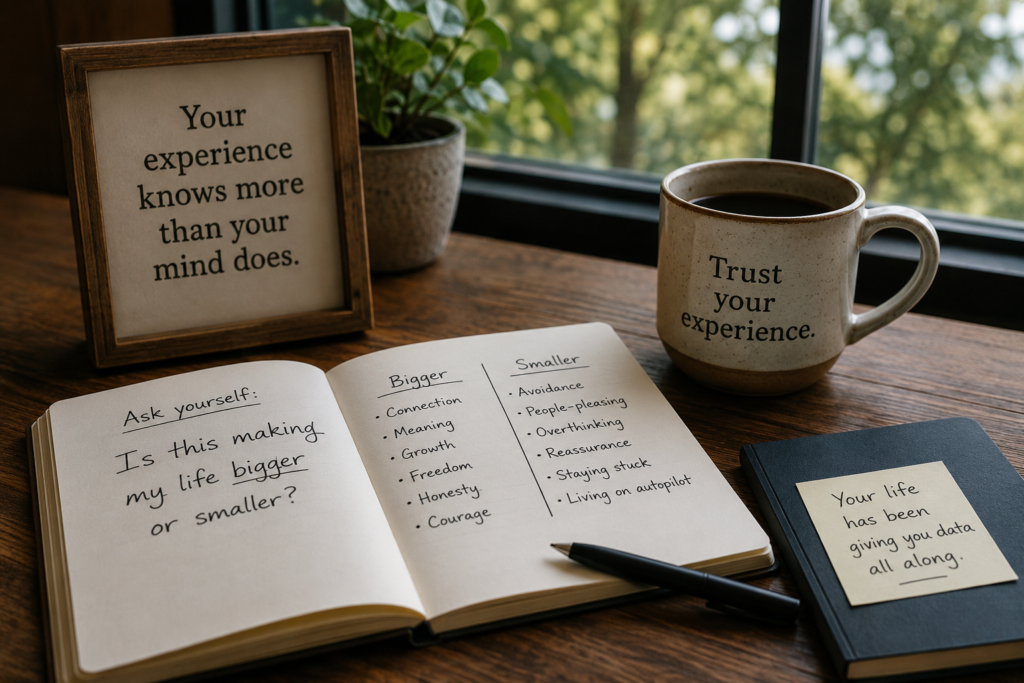
Is this making my life bigger or smaller?
Take anything you're doing, such as the over-preparing, the reassurance-seeking, the staying quiet, the extra hours, the relationship pattern you keep defending. Hold it up against that question. Don't ask whether it's logical, or whether other people approve of it, or whether it feels safer, ask what it's actually doing to the size of your life.
Bigger looks like more of what matters to you: closer relationships, work that means something, the freedom to be somewhere new without a script. Smaller looks like a life increasingly organised around avoiding discomfort, fewer risks, fewer honest conversations, less of you showing up.
Your feelings will sometimes vote for smaller. Avoidance always feels sensible in the moment; that's precisely how it survives. This is why the question matters: it asks your experience to testify, not your fear. The racing heart before you speak up is real, and it's uncomfortable, but discomfort isn't the same as a warning. Sometimes it's simply the price of a bigger life. Your experience, if you look back honestly, already knows which moments of discomfort were worth it.
Don't take my word for it - including this
Here's the part that might sound strange coming from a therapist: I don't want you to believe me either.
When I work with someone, I'm offering ideas, frameworks, and strategies drawn from training and years of clinical work. That's useful information. It is still only information, the same category as every other opinion in your life, even if it arrives with credentials attached.
The real authority in the room is your experience. If we try something in therapy and your life gets bigger and you're doing things that matter, the struggle loosens its grip and then we're onto something, and we know it not because I said so, but because your experience confirmed it. If we try something and it isn't working, I want to know, because that feedback matters more than my professional opinion.
I work this way deliberately. The goal of good therapy isn't to give you a wiser voice to depend on, it's to help you rebuild trust in your own, so that eventually you don't need me at all. Any approach that makes you more dependent on the expert has, in my view, missed the point entirely.
Where to start
You don't need to overhaul anything this week. Start by noticing.
Pick one recurring situation - the decision you keep deferring, the reassurance you keep seeking, the invitation you keep declining. Before you respond the way you usually do, pause and ask: what has my experience actually shown me here? Not what does my mind predict. Not what would others say. What has actually happened, the times I've done this before?
Then, if you're willing, run a small experiment. Do the thing your mind advises against - send the email without the sixth re-read, give the honest answer, take the rest without earning it - and watch what actually happens. Not what your mind says happened; what happened. This is how self-trust gets rebuilt: not through positive thinking, but through evidence, gathered one honest observation at a time.
You've spent years collecting other people's answers. Your own life has been quietly collecting data the whole time. It might be worth finally reading it.
· · ·
Recognise yourself in this?
If you recognise yourself in this - the overthinking, the second-guessing, the exhausting search for certainty - therapy can help you learn to trust your own experience again.
I offer a free 15-minute phone consultation: no obligation, just a conversation.