
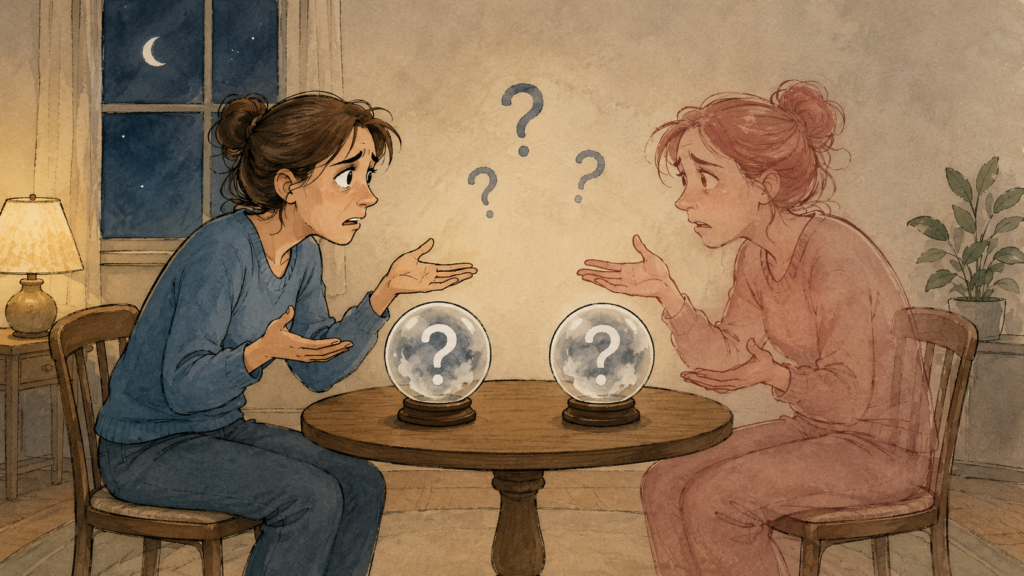
It's late, the room is dark, and you're deep in a debate with your own mind. It says something will go wrong. You marshal the evidence for why it won't. It comes back with a new worry. You answer that one too. An hour passes and you're no closer to winning, only more awake.
If that sounds familiar, you're not alone. This is a common pattern that people get stuck in, feeling exhausted not by their anxiety itself but by the endless arguing with it. They've become skilled advocates in a court case that never reaches a verdict. And the reason it never resolves is simpler, and kinder, than most people expect. You cannot win an argument about something that hasn't happened yet, and neither can your anxiety. You're both just guessing.
The argument you keep having
The argument takes many forms and it rarely looks like arguing. It looks like preparing. It looks like being responsible. You run the meeting in your head one more time so you'll be ready. You draft the message, delete it, rewrite it, and read it back searching for anything that could be taken the wrong way. You go looking for reassurance, from a colleague, from a search engine, from your own memory of how the last one went, and the relief lasts about as long as it takes for the next "but what if" to arrive.
Underneath all of it is the same move. A worried prediction shows up, and you try to answer it. You meet the thought with a counter-thought and wait for the feeling to settle. Sometimes it does, briefly. More often the worry simply changes shape and comes back for another round, because the thing you're really trying to settle is not this particular worry. It's the uncertainty behind it, and uncertainty does not respond to a good argument.
Why neither of you can win
Here is the part that changes things once you see it. Your anxious mind is not reporting the facts of your situation. It's making a prediction.
The brain is a prediction machine. It's constantly using the past to guess at what's coming so it can keep you safe, and when it senses a threat it does exactly what it evolved to do, it sounds the alarm and urges you to prepare or avoid. That system is not broken, it's doing its job. The trouble is that it can't always tell the difference between a real lion and a virtual one. A genuine physical danger and a difficult conversation, a piece of feedback, or the possibility of getting something wrong all pull the same lever. So the alarm fires for a presentation exactly as it would for a predator, and the prediction it hands you, this will go badly, you're not ready, you'll be found out, arrives feeling less like a guess and more like a fact.
But it is a guess, an educated one, built from old information and a mind that's biased towards spotting danger, yet still a guess about a future that hasn't arrived. And when you argue back, no it won't, I am ready, I'll be fine, you're offering a guess of your own. Two predictions, neither of which can be proven from the armchair, both certain they're right. That's why the debate never ends. There's no evidence in the room, because the event is still in the future.
There's a further catch, and it's the important one. Arguing with the worry is itself a message to your brain. Every time you treat a thought as an emergency that has to be answered right now, you're signalling that it's dangerous, that it needs handling before you can rest. The brain hears that and does the helpful thing, it keeps the threat system switched on. The very act of trying to think your way to safety tells your mind you're not safe yet. This is how the loop sustains itself. The strategy trying to solve the problem quietly becomes the problem.
You're not trying to answer a question. You're trying to remove a feeling of uncertainty, and you can't reason your way to certainty about something that hasn't happened.
· · ·
What to do instead of arguing
If winning the argument isn't the way out, what is? Not another technique for building a better case, but a different relationship with the thought in the first place.
Start by noticing that a thought is a thought, not a bulletin from the future. "I'm going to mess this up" and "It's possible I might mess this up, and there's my mind predicting again" are the same words held in completely different ways. The second one gives you a little distance. You can see the prediction as a prediction, acknowledge that your mind is doing its protective job, and decline the invitation to litigate it. You don't have to prove it wrong. You don't have to prove it right. You can let it be there, an opinion offered by a nervous part of you, without handing it the final word.
Then let the uncertainty stay. This is the hardest part and the whole point of it. Anxiety wants certainty and comfort, and the reassurance-seeking, the over-preparing, the mental rehearsal are all attempts to get it. Willingness is the opposite move. It's the ability to go into the meeting, send the message, make the decision, while genuinely not knowing how it will land. Not because you've silenced the doubt, but because you've stopped making its silence a condition for living your life.
So instead of a counterargument, try a stance. Something closer to, you might be right. I honestly don't know and I'm doing this anyway. That single response does what an hour of debating cannot. It acknowledges the worry without dismissing it, it refuses to treat it as an emergency, and it sends your brain a very different message, this is uncomfortable, but it isn't dangerous, and I don't need protecting from it right now. You're no longer feeding the loop. You're stepping out of it.
A useful question to hold alongside all this is a simple one about workability. Is arguing with your anxiety making your life bigger or smaller? Does another lap of the debate move you towards the meeting, the relationship, the work that matters to you, or does it keep you circling in your own head, safe and stuck? You don't have to judge the thought as true or false. You only have to notice what arguing with it actually does, and whether it's taking you where you want to go.
Let your experience be the judge
There's a reason the argument feels so urgent and so unwinnable, and it's that the whole thing takes place in the one arena where nothing can be settled, your imagination. Prediction lives there. Certainty is never available there. The only place the question can actually be answered is out in your life, through experience.
This is what I mean when I talk about trusting your experience. Your anxious mind will keep forecasting, that's what it's for, and its forecasts will keep feeling true. But you have another source of information that's far more honest, which is what actually happens when you act. The presentations you've delivered. The conversations that went better than the rehearsal in your head insisted they would. The track record you tend to discount the moment the next worry appears. Every time you do the thing while the doubt is loud, you're not just getting through it, you're giving your brain new evidence, updating an old prediction with something real. You can't argue your way to that. You can only live your way there.
So the next time you find yourself building the case for why it won't go wrong, notice what you're doing, and consider putting the argument down. Not because you've defeated the worry, but because you've realised you don't need to win. Let the thought be a guess. Let the uncertainty be uncomfortable. Then take one small step in the direction that matters and let your experience, not your prediction, have the final say.
You're not broken. You're stuck in an argument that was never yours to win.
· · ·
Recognise yourself in this?
If the endless internal debate is wearing you down, and you'd like some help changing your relationship with anxiety rather than fighting it, therapy can make a real difference.
I offer a free 15-minute phone consultation, no obligation, just a conversation.