
The feedback is good. The promotion happened. The work keeps landing well. So why is there still a voice insisting that sooner or later, someone is going to realise you don't belong here?
If you live with that voice, you've probably tried to reason with it. You've listed your qualifications, replayed the successes, and somehow the voice always has a comeback: that was luck. They were being kind. You fooled them.
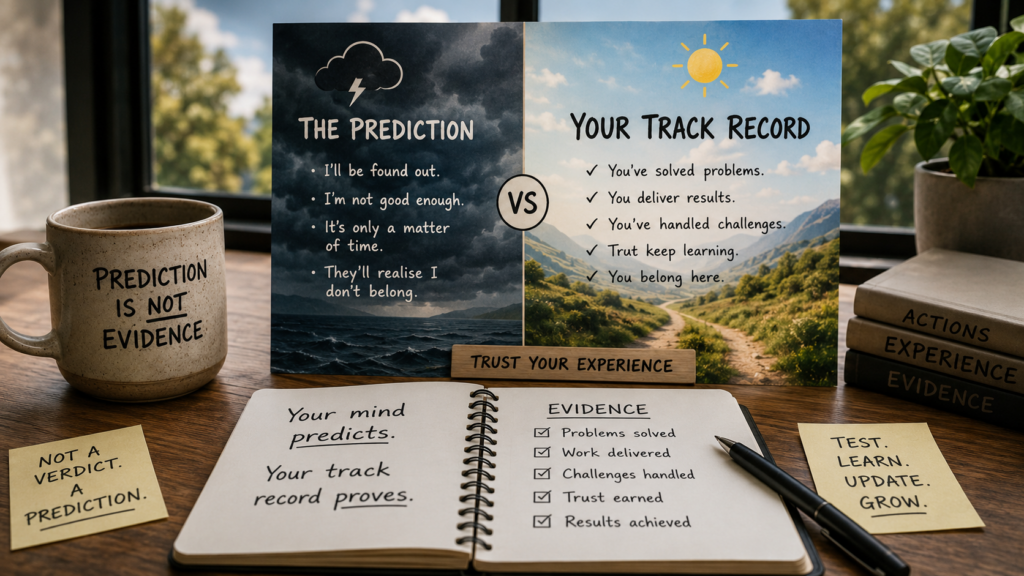
Here's a different way to understand what's happening, one that changes what you do about it. That voice isn't a verdict on your competence. It's a prediction, and your actual track record is the evidence it keeps ignoring.
Your brain is a prediction machine
Underneath all of this sits something worth knowing about how minds work. Your brain doesn't passively experience the world and then react to it. It predicts - constantly, automatically, ahead of events. It takes everything that's happened to you before and uses it to forecast what's about to happen next, mostly so it can protect you from whatever it forecasts.
This is enormously useful. It's why you can catch a ball, sense a conversation turning awkward, or brake before you've consciously registered the car in front slowing down.
But the prediction machine has two habits that matter here. First, it's biased towards threat - a brain that over-predicts danger keeps you alive more reliably than one that under-predicts it. Second, it weights emotionally charged memories most heavily. The moment you felt humiliated in a meeting years ago counts for more, in prediction terms, than the two hundred meetings that went fine.
So if your history includes moments of shame, criticism, or feeling out of your depth - and whose doesn't - your brain has filed those away as important data. When you step into a high-stakes situation, it reaches for exactly those files and produces its forecast: this is where you get found out.
That forecast is imposter syndrome. It isn't insight into your true ability. It's your brain making a guess, based on old, selectively weighted information, with entirely protective intentions.
· · ·
Why the prediction feels so true
If it's just a guess, why does it feel like the truth?
Partly because predictions arrive dressed as feelings. The forecast doesn't announce itself as a forecast - it shows up as a tight chest before you speak, a wave of dread when the email arrives, a sudden conviction that everyone else in the room knows more than you. Feelings are compelling. When something feels true, the mind rarely pauses to ask whether it is.
But there's a second reason, and it's the one that keeps the whole pattern running: the prediction always gets in first.
The forecast arrives before the event. And if you respond to it - by over-preparing, staying quiet, deflecting the credit, avoiding the stretch assignment - you never collect the experience that would have tested it. The meeting where you spoke up unscripted and it went fine? It never happened, because you scripted everything. The prediction goes untested, and untested predictions quietly get promoted to facts.
Worse, the things you do to stay safe end up stealing the evidence. If you over-prepare for every presentation and the presentation goes well, your mind doesn't conclude I'm capable. It concludes I only got away with it because I over-prepared. The success gets credited to the safety behaviour, not to you. You can spend years accumulating achievements this way and feel no more secure at the end of them - because none of the achievements were ever allowed to count.
This is worth sitting with, because it explains something that puzzles many of the people I work with: why success doesn't fix imposter syndrome. More achievement doesn't update the prediction, because the prediction was never about your achievements. It runs on older data - and it discounts every new result that contradicts it.
Your track record is the evidence
Here's what I'd invite you to notice: there are two sources of information about your competence, and they're telling different stories.
Your mind's prediction says you're about to be exposed. Your track record - the problems you've actually solved, the work you've actually delivered, the responsibilities you've actually carried - says something else entirely.
One of these is a forecast built from your most painful moments. The other is a record of what has actually happened, gathered over years, in the real world, with real results.
I wrote recently about learning to trust your experience over what your mind tells you. Imposter syndrome may be the clearest example of why that matters. When the forecast and the record disagree this consistently, the honest move isn't to keep believing the forecast. It's to start reading the record.
And to be clear about what this isn't: it isn't positive thinking. I'm not asking you to tell yourself you're brilliant. I'm asking you to look at data that already exists.
You can't argue with it - but you can test it
A tempting response to all of this is to start debating the voice. Build the case. Win the argument.
It rarely works, and it's worth understanding why. The prediction concerns the future - you'll be found out - and you cannot win an argument about something that hasn't happened yet. Your mind predicts exposure; you predict you'll be fine; neither of you actually knows. Meanwhile, the argument itself keeps the whole question of your adequacy centre stage, which is exactly where you didn't want it.
What updates a prediction isn't argument, it's evidence, and evidence comes from doing the things the prediction warns you against - in small, deliberate doses - and letting the outcome be counted.
Speak once in the meeting without rehearsing the line. Submit the work at good-enough rather than bulletproof. Accept the compliment with "thank you" instead of an explanation of why it was nothing. Then - and this is the part that matters - pause afterwards and take honest note of what actually happened. Not what your mind says happened. What happened.
Each time you do this, you're doing something quietly powerful: you're giving your prediction machine new data. Behaviour is the most convincing message you can send your own brain. Every experiment that goes fine - and most will - chips away at the old forecast and builds a newer, more accurate one.
One more thing, because it changes the spirit of the work: this isn't a battle with a defective brain. Your prediction machine is doing exactly what it was built to do, using the information it was given. It's not your enemy - it's just working from old files. You're not broken. You're stuck in a loop that makes complete sense once you can see it - and loops that make sense can be changed.
You're not broken. You're stuck in a loop that makes complete sense once you can see it.
And loops that make sense can be changed.
Where to start
This week, catch one prediction before it runs the show. Before the meeting, the email, the conversation, notice what your mind is forecasting - you might even write it down. They'll think the idea is weak. I'll go blank. I'll be exposed.
Then do the thing anyway, at whatever size feels possible, and afterwards compare the forecast with the outcome.
That gap between what your mind predicted and what actually happened? That's not a small thing. That gap is where your self-trust gets rebuilt - one tested prediction at a time.
· · ·
Recognise yourself in this?
If imposter syndrome is shaping how you work, what you put yourself forward for, or how exhausted you feel at the end of a week - therapy can help you change your relationship with it.
I offer a free 15-minute phone consultation: no obligation, just a conversation.