
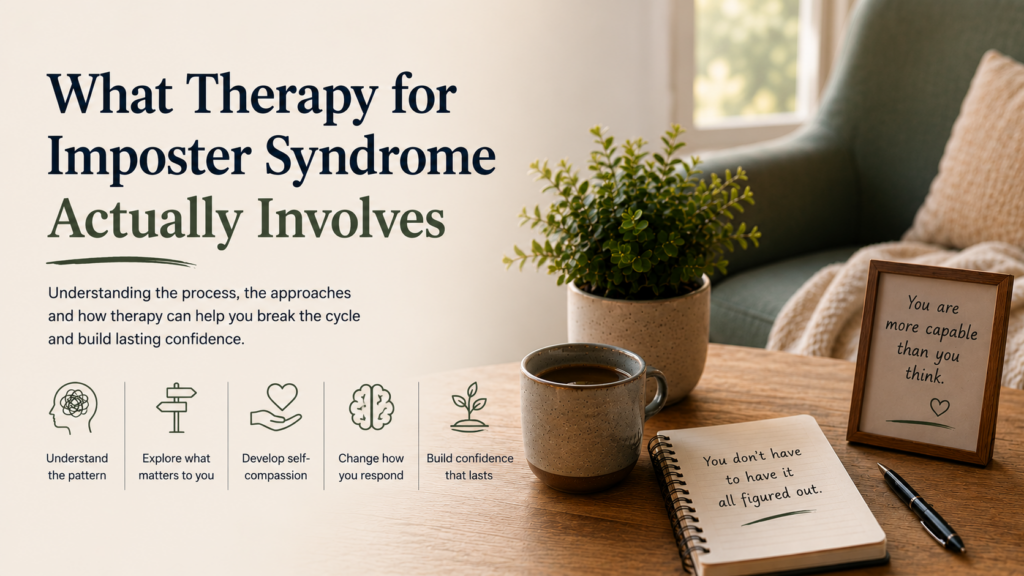
Most people who consider therapy for imposter syndrome have already spent a long time trying to sort it out themselves. They've read about it, understood it intellectually, perhaps tried some of the self-help strategies - and found that while all of that helped up to a point, something remained unchanged underneath. The self-doubt kept returning. The anxiety before high-stakes situations stayed. The pattern carried on regardless of how much they knew about it.
If that's where you are, therapy probably isn't what you need more information about. What's more useful is a clear picture of what it actually involves - what happens in sessions, what the process feels like, and how you might know whether it's the right next step.
What the early sessions look like
Therapy for imposter syndrome doesn't begin with techniques or exercises. It begins with understanding - yours and mine.
The early sessions are primarily about getting a clear picture of what's actually happening for you: the specific situations that trigger self-doubt, the thoughts that follow, the behaviours those thoughts drive, and the impact the pattern is having on your work and your life. This isn't just information-gathering. Most people find that simply mapping the pattern carefully - with someone who isn't going to judge it or rush to fix it - starts to shift something. Things that felt overwhelming and formless begin to have a shape.
This is also where we start to make sense of where the pattern came from. Not in a way that's about excavating the past for its own sake, but in a way that helps explain the present. For most people, imposter syndrome makes complete sense in the context of their history - the environments they grew up in, the experiences that shaped how they learned to relate to achievement and failure, the internal rules that formed early and have been operating quietly ever since. Understanding this tends to reduce the shame and self-criticism that usually accompany the pattern considerably. It moves the question from what's wrong with me? to why does my mind work this way - and what can I do with that?
What the work involves
Once the pattern is mapped and understood, therapy moves into something more active. This is where the clinical approaches I draw on come in - not as separate modules applied in sequence, but woven together responsively depending on what's most useful at any given point.
CBT work tends to focus on the thinking patterns that maintain the cycle - the automatic beliefs that fire when imposter syndrome activates, and the ways those beliefs get tested and gradually updated through experience rather than just reasoning. This might involve looking carefully at the evidence for and against a particular belief, or noticing the way a thought like I got lucky functions to explain away success before it has the chance to land.
ACT work focuses on the relationship with difficult thoughts and feelings rather than their content. Rather than trying to change what the mind says, it builds the capacity to hold thoughts differently - to notice I'm going to be found out as something the mind produces, rather than a fact that demands a response. Alongside this, values work clarifies what actually matters beneath the anxiety, and gradually shifts behaviour from fear-led to values-led.
CFT addresses the shame and self-criticism that tend to sit at the heart of imposter syndrome - the harsh inner voice that drives the overworking, the checking, the holding back. The goal isn't to lower standards or become complacent. It's to develop a steadier, more grounded internal voice - one that responds to difficulty with the same compassion you'd offer someone you care about, rather than with intensified self-attack.
Where imposter syndrome is rooted in specific memories or earlier experiences that still carry an emotional charge, EMDR can reach something that the other approaches don't quite access. It works directly with the emotional and physiological response those memories still produce, helping the brain complete the processing it wasn't able to do at the time. Memories that previously felt raw and present begin to feel like the past - still there, but no longer active in the same way.
What it feels like
Therapy for imposter syndrome is rarely as uncomfortable as people expect, particularly in the early stages. Most people describe the initial sessions as something of a relief - the experience of having the pattern understood rather than judged, and of it making sense in a way it hadn't before.
The more active work - sitting with uncomfortable thoughts rather than escaping them, practising new ways of responding, taking valued action in the presence of self-doubt - involves genuine effort. But it's paced carefully. Nothing is pushed before the foundations are in place, and the pace of the work is always something we discuss rather than something that gets decided for you.
Most people notice change gradually rather than dramatically. Not a sudden absence of self-doubt, but a shift in its relationship to what they do. The imposter voice becomes something they can hear without obeying. Decisions start to be made from what matters rather than from what threatens. The exhaustion of constantly managing the anxiety begins to ease.
How to know if you're ready
The most common thing people say when they first contact me is some version of: I'm not sure if I'm bad enough to need therapy. This is worth addressing directly.
Therapy isn't reserved for crisis. It's appropriate whenever a pattern is significantly affecting the quality of your work, your relationships, or how you experience your life - and when the strategies you've been using to manage it have reached their limits. If imposter syndrome is costing you energy, opportunities, or wellbeing on a regular basis, that's enough of a reason.
You also don't need to feel ready in the sense of having things sorted or knowing what you want to work on. That's what the early sessions are for. The only thing that's genuinely needed at the start is a willingness to be curious about what's happening - which, if you've read this far, you probably already have.
If you'd like to find out more about whether therapy might be helpful for you, I offer a free 15-minute phone consultation - no obligation, just a conversation.