
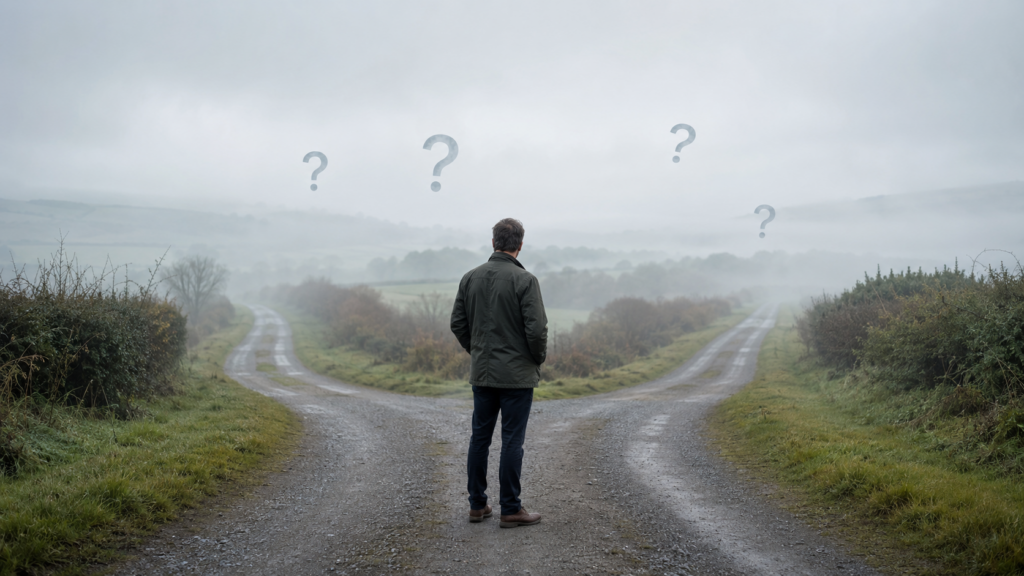
You've been going over the same decision for days. You've weighed it up, talked it through, written a list, unwritten the list, and you're still no closer to feeling sure. Every time you get close to choosing, another "but what if" arrives and pulls you straight back to the start.
If that sounds familiar, you're not simply indecisive, and there's nothing wrong with you. Something more specific tends to be going on underneath, and once you can see it clearly, decisions start to feel different.
Why decisions feel so loaded
For a lot of the professionals I work with, the hard part isn't really the decision itself. It's what the decision seems to represent. Choosing the wrong project, the wrong job, or the wrong words in a meeting can feel less like a practical misstep and more like proof of something about you: that you're not as capable as people think, that you'll be found out.
Underneath most of it sits a single, quiet demand: I need to be sure before I act. Sure it's the right move. Sure it won't go wrong. Sure it won't expose me. That sounds reasonable, sensible even. But it's also where the trap begins.
Anxiety wants certainty and comfort
Here's the part that tends to make sense of everything else. The mind is a problem-solving machine, and it's brilliant when the problem is out there in the world. The difficulty starts when it turns that same energy inward, onto the feeling of uncertainty itself, and treats "I don't know for sure" as a danger to be removed.
So it sets to work in the only ways it knows. It tells you to think harder, to gather more information, to run the scenarios one more time, to check what other people would do, to wait until you feel ready. Each of these seems to promise the certainty you're reaching for, and each one, in the moment, brings a small flicker of relief.
The problem is that certainty was never really available. No decision that matters comes with a guarantee. So the relief fades, the doubt comes back, and round you go again. This is the piece worth holding onto: the strategies trying to solve the problem slowly become the problem. The harder you chase certainty, the more your mind becomes convinced the decision genuinely is dangerous, and the heavier the whole thing feels.
The quiet cost of needing to be sure
In therapy we'd think of the overthinking, the endless researching, the reassurance-seeking and the delaying as "away moves". They move you away from discomfort in the short term, and they make complete sense as ways of trying to feel safe. But they carry a cost. Each time you hold off deciding until certainty arrives, you teach your mind that the uncertainty really was worth fearing, and the loop pulls a little tighter.
Over time you start to notice it in other places too. In the opportunities you talk yourself out of because they feel too exposed. In the way you play it safe to avoid scrutiny. In saying yes to things you don't want simply to avoid letting someone down, or handing decisions to other people so you're not the one to blame if it goes wrong. None of this is weakness. It's what tends to happen when the need to be sure is the thing running the show.
A different way to make decisions
The way through isn't to become more certain. It's to change your relationship with not knowing.
That begins with awareness, with catching the pattern while it's happening rather than after the event. Noticing the moment the search for certainty kicks in, the familiar pull to research one more time or ask one more person. You can't step out of a loop you can't yet see, so this alone tends to shift more than people expect.
From there, the work is learning to make room for the discomfort of uncertainty instead of trying to solve it away. Letting the doubt be present without letting it make the decision for you. And then choosing based on something steadier than whichever option feels safest in the moment: your values, what genuinely matters to you here, the direction you actually want to be heading in.
Approaches like CBT, ACT and CFT give us practical ways to do exactly this. To step back from anxious thoughts without getting drawn into arguing with them. To soften the self-criticism that turns every choice into a test you might fail. To move in line with what matters while the doubt is still talking in the background. Confidence doesn't arrive first and then allow you to decide. It works the other way round. You act, and the confidence follows, built from the growing evidence that you can handle not being sure.
None of this means every decision suddenly becomes easy, or that the doubt disappears altogether. You don't need to get rid of the uncertainty before you can get on with your life. You need to be able to move forward alongside it, and that is a very different and far more freeing place to make decisions from.
· · ·
When it's time to get some support
If you recognise yourself in this, the constant second-guessing, the sense that one wrong move will give you away, the tiredness of never quite feeling sure, it really doesn't have to stay this way. You're not broken, you're stuck, and stuck is something we can work with together.
I offer a free 15-minute phone consultation. No obligation, just a conversation about what's going on and whether therapy might be a good fit.