
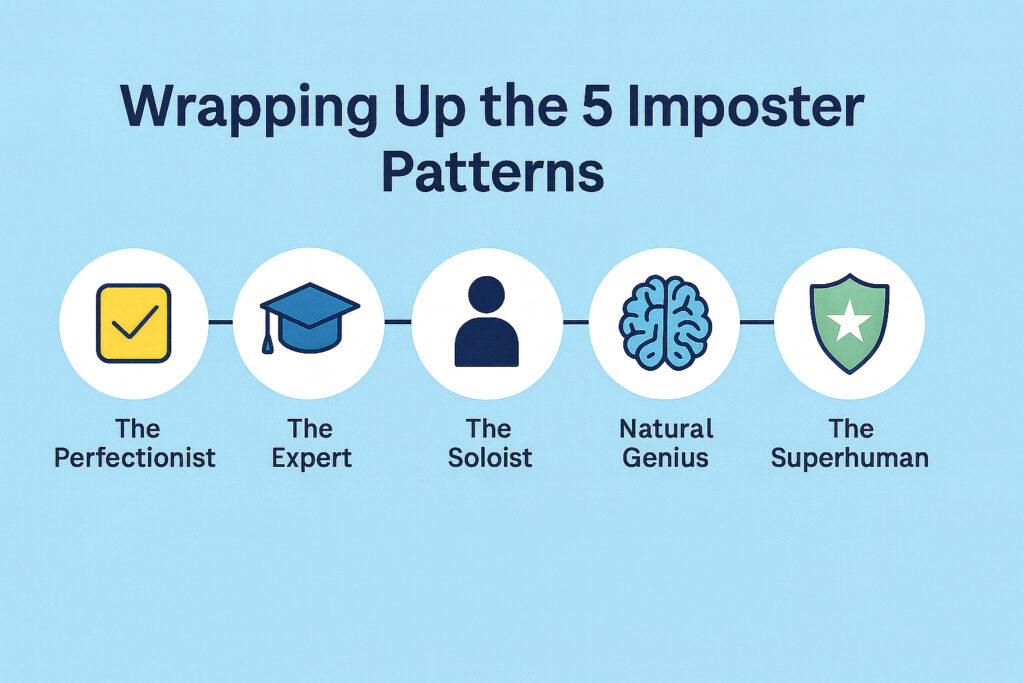
The Five Imposter Types Summary
Over the past few weeks, I’ve shared a series of posts exploring five common imposter patterns: the Perfectionist, Expert, Soloist, Natural Genius, and Superhuman, as identified by the work of Dr Valerie Young.
This final post brings everything together. It’s not another “type” or framework to memorise, it’s a chance to step back and make sense of what these patterns mean.
These aren’t fixed categories or personality types, they’re patterns of coping or ways our minds try (sometimes unhelpfully) to manage self-doubt, uncertainty, and the fear of being exposed or inadequate.
And once we can see them for what they are, we can begin to relate to them differently.
🧩 The Five Patterns, in Brief
Each of these imposter patterns has the same goal which is to protect you from feeling not good enough, but they all go about it in different ways.
-
The Perfectionist: avoids failure by chasing flawlessness.
-
The Expert: tries to outrun doubt by knowing everything.
-
The Soloist: equates competence with doing it alone.
-
The Natural Genius: believes struggle means inadequacy.
-
The Superhuman: ties self-worth to endless doing.
Different situations might bring out different patterns, and you might notice several of them in yourself, or even shifting from one to another depending on the context.
That’s completely normal and these patterns are fluid, not fixed.
🧭 How to Work With These Patterns
Instead of trying to eliminate imposter thoughts or “fit” into one box, the real work lies in understanding your patterns and how they operate.
-
Notice which situations trigger them.
-
Acknowledge the fears or emotions underneath.
-
Respond with awareness and compassion rather than criticism.
-
Reconnect with your values - the reasons you choose to show up despite the discomfort.
Through that lens, each pattern becomes a cue for growth rather than something to fix.
🌟 A Final Reflection
Imposter feelings are rarely signs of incompetence, they’re signs of caring deeply, and they show up most where you value competence, connection, and contribution.
The goal isn’t to “beat” imposter syndrome but to build flexibility which is the ability to notice the patterns, make room for discomfort, and move towards what truly matters.
You’re not an imposter, you’re simply human, navigating a demanding world with a mind that’s trying, in its own imperfect way, to protect you.
👉 If you’ve been following the series, I hope this summary helps you connect the dots.
You can find all five posts on my website and LinkedIn profile, each exploring these patterns, and with practical ways to respond differently.