
Ever felt like you're doing well on paper, but quietly waiting for someone to realise you don't quite deserve it?
Maybe it shows up before a big meeting, when you get positive feedback you can't quite accept, or when you take on more responsibility and find the self-doubt gets louder rather than quieter. From the outside, it looks like drive and conscientiousness. On the inside, it's exhausting - a private pressure that never fully lets up.
If that sounds familiar, the first thing worth knowing is that it makes sense. Imposter syndrome isn't a sign that something is fundamentally wrong with you. It's a pattern - one that develops when a mind shaped by high expectations and past experiences tries its best to keep you safe. And like most patterns, once you can see it clearly, it becomes something you can actually work with.
Over the years, I've found that what helps most isn't trying to get rid of imposter feelings - that approach tends to make things worse, not better. What helps is a structured process that builds understanding first, and action from there. That's what the Awareness to Action Framework is designed to do.
What Is the Awareness to Action Framework?
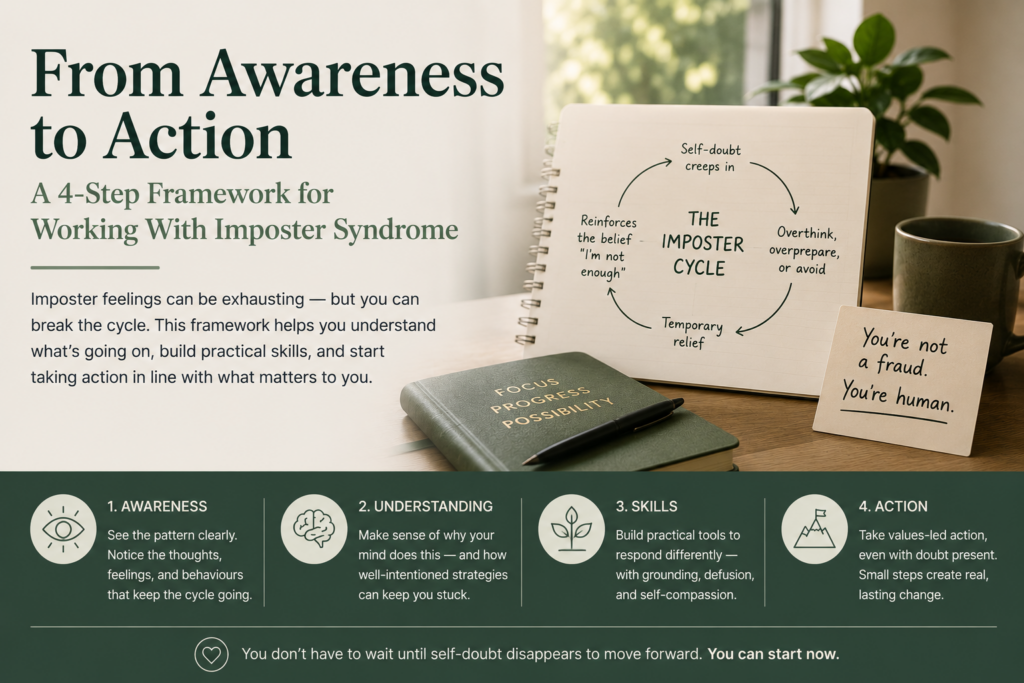
The Awareness to Action Framework is the process I use in therapy to help people move from feeling trapped by self-doubt to being able to act in line with what actually matters to them - even when doubt is still present.
It draws on four evidence-based approaches: Cognitive Behavioural Therapy (CBT), Acceptance and Commitment Therapy (ACT), Compassion Focused Therapy (CFT), and EMDR. Not as separate options, but woven together into a single, coherent process - one that's responsive to the individual rather than formulaic.
The framework has four steps: Awareness, Understanding, Skills, and Action. They aren't strictly linear - in practice, you'll often be working on more than one at the same time, and occasionally it makes sense to start somewhere other than the beginning. But the structure matters. It gives the work shape, and it helps you understand at any given point what's being targeted and why.
Step 1: Awareness - Seeing the Pattern Clearly
You can't change what you can't see. That sounds obvious, but it's easy to underestimate how much of the imposter syndrome cycle operates below conscious awareness - a habitual rush of anxiety before a presentation, an automatic dismissal of positive feedback, a pattern of overworking that feels like diligence but is quietly driven by fear.
The first step is developing the ability to observe what's actually happening: the specific situations that trigger self-doubt, the thoughts that follow, the feelings those thoughts generate, and the behaviours that result. Not in a self-critical way - more like becoming a curious observer of your own patterns rather than someone swept along by them.
This also means looking honestly at the impact. What is the imposter syndrome cycle actually costing you - in energy, in opportunities, in how you experience your work and your life? This isn't about dwelling on what's going wrong. It's about getting clear on what you'd like to be different, which is what gives the rest of the work its direction.
Step 2: Understanding - Making Sense of the Mind
Awareness tells you what's happening. Understanding tells you why - and this is often where something important shifts.
I find it useful to think of the mind as a problem-solving machine. It's a genuinely brilliant system for external challenges - things you can plan, act on, or decide. But when it turns inward and tries to solve uncomfortable feelings, it runs into difficulty. You can't think your way out of self-doubt in the same way you'd work through a practical problem. Yet the mind keeps trying: prepare more, check again, seek reassurance, avoid the situation entirely.
Each of these strategies makes complete sense. In the short term, they bring relief. But they also quietly reinforce the idea that the discomfort was a threat worth escaping - which means it tends to come back stronger. The harder you fight the feeling, the tighter it grips. It's a bit like a Chinese finger trap: the instinctive response makes the problem worse, not better.
Understanding this doesn't make the feelings disappear. But it does change your relationship with them. Instead of concluding that you're not good enough, you begin to see that you're caught in a cycle - one that your mind created with good intentions, and one that can be worked with differently.
This shift - from self-blame to understanding - is one of the most important things that happens in therapy.
Step 3: Skills - Learning to Respond Differently
Once the pattern is visible and understood, therapy moves into practice. Because understanding alone, while valuable, isn't quite enough. The instinctive pull of old habits is strong, and new ways of responding need to be learned and practised before they become available in the moments that matter.
This is where specific psychological skills come in.
Grounding techniques - like Dropping Anchor - help you stay present and steady when anxiety or self-doubt spike, rather than being swept into a spiral of overthinking. Defusion techniques, drawn from ACT, help you step back from thoughts rather than getting tangled in them - noticing a thought like "I'm going to be found out" without treating it as a statement of fact that demands a response. Self-compassion practices, from CFT, help soften the harsh inner critic that tends to sit at the heart of imposter syndrome - not to lower standards, but to respond to difficulty with the same kindness you'd offer someone else in the same situation.
These aren't quick fixes, and they don't need to be. They're practical habits that, built gradually, start to create real flexibility - the ability to meet difficult thoughts and feelings without automatically acting on them.
Step 4: Action - Moving Towards What Matters
The final step is also, in some ways, the most important - because this is where the work becomes visible in daily life.
A common and understandable trap in imposter syndrome is the belief that action should wait until confidence arrives. That once the self-doubt settles, once things feel a bit clearer, once you feel a bit more ready - then you'll speak up, take the opportunity, stop holding back. But confidence doesn't tend to work that way. It's usually the result of action, not the precondition for it. Waiting for it to arrive first keeps the cycle going.
This step involves clarifying what actually matters to you - the values and goals that feel genuinely important, beneath the anxiety and the self-doubt - and beginning to take small, deliberate steps in that direction, even when discomfort is present. Not recklessly, and not all at once. But consistently enough that a different pattern starts to form.
It might look like speaking up in a meeting rather than staying quiet. Submitting a piece of work without one final unnecessary revision. Accepting a compliment without deflecting it. Saying yes to something that feels stretching rather than retreating to what feels safe.
These actions don't silence the imposter voice. But over time, they change its relationship to what you do. It becomes something you can hear without obeying.
Bringing It All Together
The Awareness to Action Framework isn't about becoming a different person, or reaching a point where self-doubt never shows up. It's about changing your relationship with it - so that it no longer has the same hold over your choices, your behaviour, and how you experience your work and your life.
Most people who go through this process find that the imposter voice doesn't disappear entirely. But it gets quieter. And more importantly, it stops being the thing that decides what you do next.
To see how the four steps combine in a real course of therapy, read David's story.
If you'd like to find out more about how this approach works in practice, you're welcome to read more about imposter syndrome therapy or book a free 15-minute consultation - no obligation, just a conversation.