
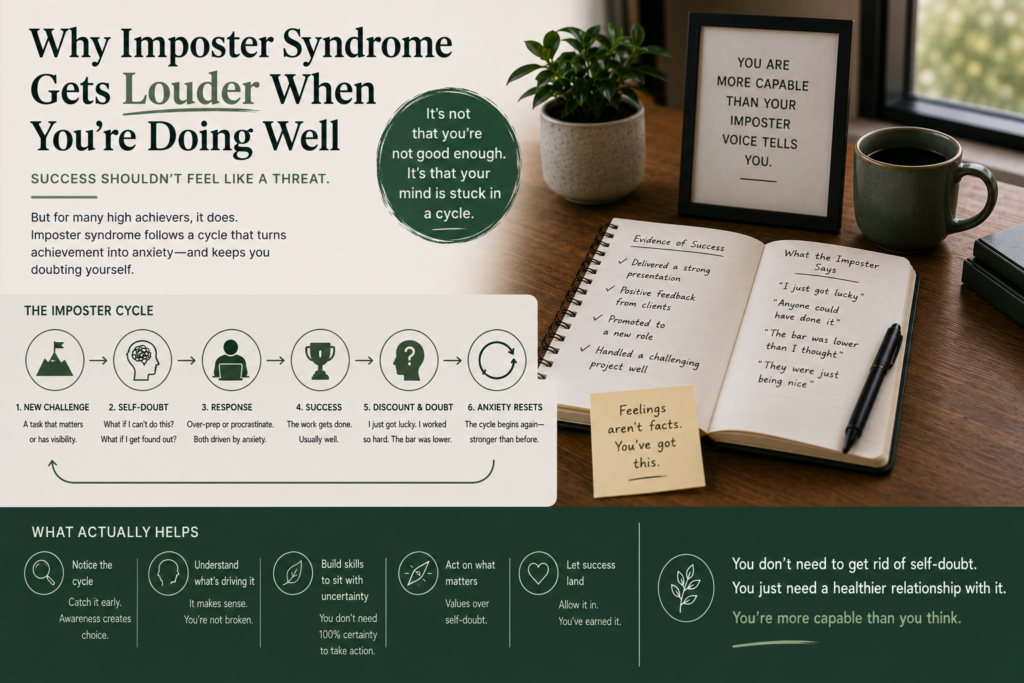
There's a particular kind of confusion that comes with doing well professionally but feeling worse about yourself than ever. The promotion arrives and instead of feeling proud, you feel exposed. The project lands well and instead of satisfaction, there's a quiet dread about the next one. The praise comes in and somehow it makes the anxiety spike rather than settle.
If that sounds familiar, you're not imagining it - and you're not alone. One of the most disorienting features of imposter syndrome is that it tends to intensify with success rather than ease. Understanding why that happens is often the first thing that helps.
Why Achievement Doesn't Fix It.
The instinctive assumption most people make is that imposter syndrome will eventually be outgrown. That once you have enough experience, enough qualifications, enough evidence of what you're capable of, the self-doubt will naturally quiet down. It's a reasonable assumption. It's also, for most people, wrong.
The reason is straightforward once you see it. Imposter syndrome isn't really about a lack of evidence. It's about how that evidence gets processed. When self-doubt is the lens, success doesn't read as proof of competence - it reads as proof that the stakes have just got higher. You've achieved something. Now there's more to lose. More people watching. More expectation to maintain. More distance to fall.
Each step forward doesn't close the gap between how capable you appear and how uncertain you feel. It widens it.
Why Achievement Doesn't Fix It.
The instinctive assumption most people make is that imposter syndrome will eventually be outgrown. That once you have enough experience, enough qualifications, enough evidence of what you're capable of, the self-doubt will naturally quiet down. It's a reasonable assumption. It's also, for most people, wrong.
The reason is straightforward once you see it. Imposter syndrome isn't really about a lack of evidence. It's about how that evidence gets processed. When self-doubt is the lens, success doesn't read as proof of competence - it reads as proof that the stakes have just got higher. You've achieved something. Now there's more to lose. More people watching. More expectation to maintain. More distance to fall.
Each step forward doesn't close the gap between how capable you appear and how uncertain you feel. It widens it.
The Role of the Threat System
Part of what's happening here is evolutionary rather than personal. The brain's threat system - the part designed to scan for danger and protect you from exclusion or failure - doesn't distinguish between physical threats and social ones. Being seen to fail, being judged as inadequate, being exposed as less capable than people believed: these register as genuine threats, and the system responds accordingly.
In the context of imposter syndrome, success activates this system rather than quieting it. The higher the visibility, the more the threat system has to monitor. The more people whose opinions could matter, the more vigilant it becomes. This is why the experience often intensifies at precisely the moments that should feel like victories - promotions, public recognition, new responsibilities.
It's not a character flaw. It's a nervous system doing what nervous systems do.
Why Some People Are More Vulnerable
Imposter syndrome doesn't affect everyone equally, and the differences are worth understanding - both because they help make sense of your own experience and because they reduce the shame that often accompanies it.
People who grew up in environments where praise was conditional, where achievement was expected rather than celebrated, or where love felt tied to performance tend to be more vulnerable. The internal template formed in those environments - I am only acceptable if I am getting it right - doesn't update automatically when circumstances change. It tends to travel with you.
Being the first in your family to reach a certain level, or one of very few people who look or sound like you in a particular environment, can also intensify imposter feelings significantly. When you don't see people who share your background reflected in the spaces you're occupying, the sense of not quite belonging has something to attach to.
And perfectionism - the belief that anything less than flawless is a form of failure - creates a situation where success is almost impossible to internalise, because there will always be something that could have been better.
What Actually Helps
The approach that doesn't work is trying to accumulate enough evidence to finally feel legitimate. More achievements, more reassurance, more credentials - the mind that's running imposter syndrome will find a way to discount all of it. The goalposts keep moving because the problem isn't really about the evidence.
What does help is changing your relationship with the self-doubt itself. Not fighting it, not trying to think your way out of it, but learning to notice it without being controlled by it. To see the thought I'm going to be found out as a thought - something the mind produces, not a statement of fact that demands a response.
This is the core of what ACT calls psychological flexibility: the capacity to hold difficult thoughts and feelings without letting them determine what you do. It doesn't make the imposter voice disappear. It means you can hear it and keep moving anyway.
Over time, acting in line with what matters to you - even when self-doubt is present, even when the threat system is running - is what gradually builds the kind of confidence that doesn't depend on everything going perfectly. Not fearlessness. Something more useful than that.
Recognise yourself in any of this?
If this resonates and you'd like to understand your own patterns more clearly.
I offer a free 15-minute phone consultation - no obligation, just a conversation.