
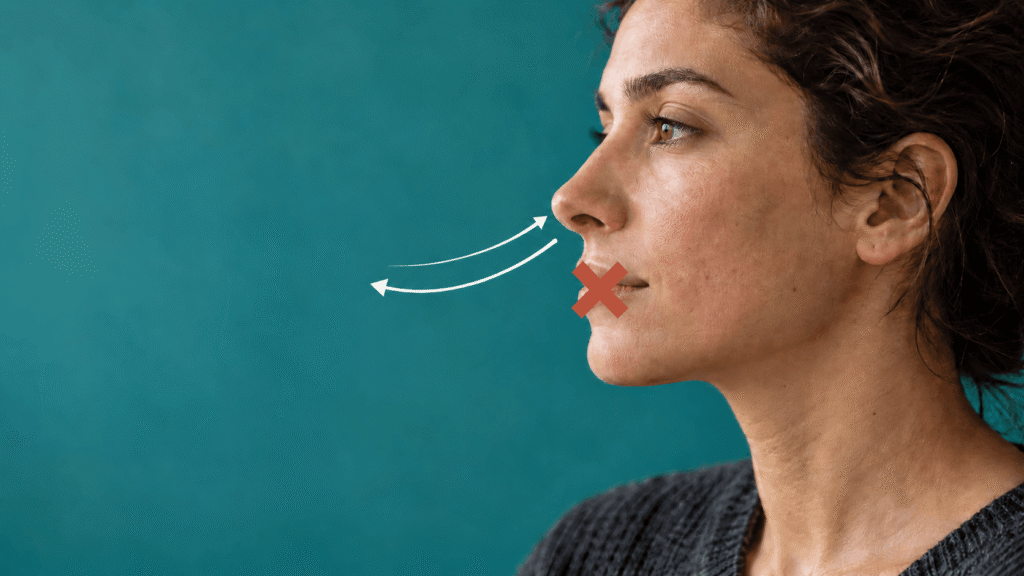
In years of CBT, ACT and CFT training, nobody ever taught me why nasal breathing matters, and plenty of the breathing exercises I was taught, inhale through the nose, exhale through the mouth, work against it without anyone meaning them to. That's an odd gap, because how you breathe has a direct line to the part of you that decides whether you're safe or in danger, and getting it wrong can quietly keep that system switched on even when nothing is actually threatening you.
What nasal breathing actually does
Breathing through your nose does several things your mouth can't. It filters, warms and humidifies the air before it reaches your lungs, which your mouth simply doesn't do. It also releases nitric oxide, produced in your sinuses, which widens the airways and blood vessels and helps oxygen move from your lungs into your bloodstream more efficiently. None of that happens when air bypasses your nose entirely.
There's a second, quieter effect that matters even more for anxiety, nasal breathing naturally slows you down. Your nostrils create a small amount of resistance that mouth breathing doesn't have, which paces your breath and helps keep your carbon dioxide levels more stable. That stability turns out to matter a lot more than most people realise.
The carbon dioxide piece nobody explains
Most people assume anxiety is about not getting enough oxygen, so the instinct is to breathe faster and harder. It's almost the opposite. When you breathe quickly through your mouth, you blow off carbon dioxide faster than your body wants to lose it, and that drop in CO2 actually makes it harder for oxygen to release into your tissues and your brain. You end up light headed, tingling, short of breath, and reaching for more air, which only drives the CO2 lower still. It's a loop that can look and feel exactly like the start of a panic attack, generated almost entirely by how you're breathing rather than anything you're thinking about.
Nasal breathing, with its built in resistance, slows that whole process down and helps keep CO2 within a range your body can actually work with.
Why this connects to the threat system, not just your lungs
This is where it stops being generic breathing advice and becomes relevant to the work I actually do. Fast, shallow, mouth driven breathing is the same physiological signature as the threat system itself, it's what your body does automatically when it's in fight or flight. If that's also your habitual, everyday breathing pattern, your body is sending itself threat signals in the background, independent of what you're thinking or worried about. That's the body area of the six-area framework I've written about recently, the one part of the threat response you can influence directly rather than just notice.
Breathe mostly through your mouth, especially on the exhale, and you're quietly reinforcing the physiological state your threat system runs on. Breathe through your nose, with its natural resistance and nitric oxide support, and you're sending the opposite signal, steady, regulated, nothing urgent happening here. Same body, completely different message, depending on which route the air takes.
Where this fits with therapy
I'm not suggesting breathing through your nose replaces therapy, or that it's a fix for anxiety on its own. But it's a genuinely overlooked piece, something that sits underneath the thinking and feeling work most therapy focuses on, influencing the nervous system directly rather than through insight or reframing. For some clients, simply noticing how much of the day they spend breathing through their mouth, and gently shifting that, removes one more thing quietly keeping their threat system primed.
Frequently asked questions
Isn't breathing through your mouth sometimes necessary, like during exercise?
Yes, during intense exercise your body needs more airflow than your nose alone can comfortably provide. The concern here is habitual, everyday mouth breathing at rest, not occasional mouth breathing during exertion.
Why do so many relaxation techniques teach exhaling through the mouth?
It's a common instruction in breathing exercises and even some CBT approaches to anxiety, likely because mouth exhaling feels like a bigger, more obvious release. The trade off is that it loses the resistance and CO2 regulation that nasal exhaling provides, which may be working against the very calm it's meant to create.
How do I know if I'm a habitual mouth breather?
Common signs include a dry mouth on waking, snoring, needing to breathe through your mouth during normal conversation, or simply noticing your mouth is open at rest without realising it.
Is this the same as other breathwork approaches?
It overlaps with work from the Oxygen Advantage method and similar functional breathing approaches, though most of that work is framed around general health and performance rather than specifically through the lens of anxiety and the threat system, which is the angle I want to bring to it here.
Get in touch
If you find yourself struggling with overthinking, second-guessing yourself, the exhausting search for certainty - therapy can help you learn to trust your own experience again.
I offer a free 15-minute phone consultation: no obligation, just a conversation.