
When self-doubt and anxiety are loud, the instinct is usually to try to quiet them down. To think things through more carefully, prepare more thoroughly, seek reassurance, or wait until the feelings settle before moving forward. These responses make complete sense. They're also, as most people who've tried them will recognise, not particularly reliable. The doubt quiets briefly and then returns. The waiting extends. The space available to move in gradually narrows.
What tends to be missing in all of this isn't a better strategy for managing the anxiety. It's a sense of direction. A clear enough answer to the question: even if the self-doubt stays, what am I moving towards?
That's where values come in.
What values actually are
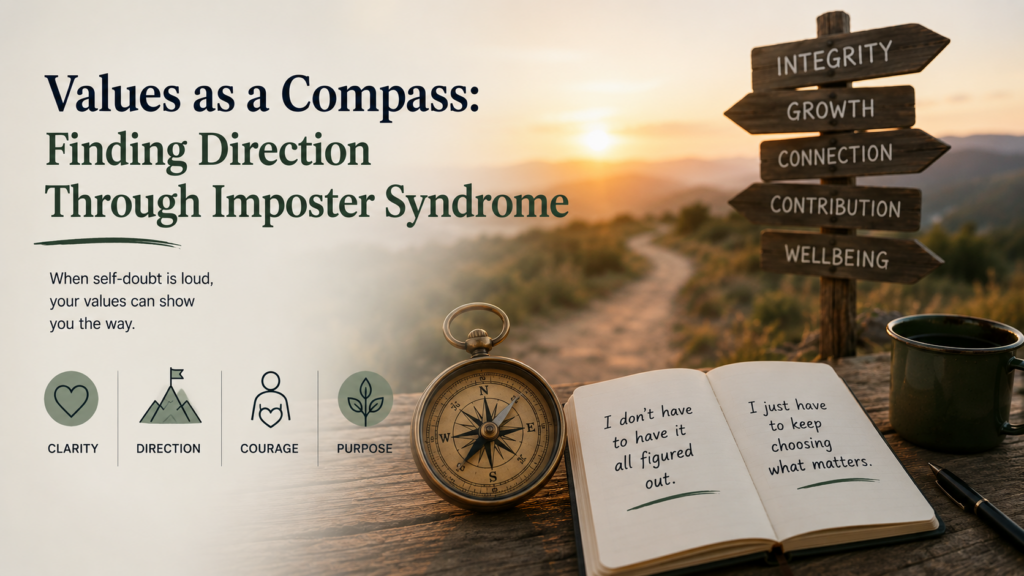
Values are often described in therapy as a compass — and it's a metaphor worth taking seriously rather than just nodding at. A compass doesn't tell you the terrain will be easy, or that the weather will be good. It doesn't guarantee you won't get lost. What it does is give you a consistent direction to orient towards, regardless of what conditions you find yourself in.
In ACT - Acceptance and Commitment Therapy - values are defined as freely chosen, personally meaningful directions for living. Not destinations to arrive at, but ongoing qualities of action: how you want to show up, what you want to move towards, what kind of person you want to be in your work, your relationships, and your life.
This distinction between values and goals is one of the most practically useful ideas in ACT, and it matters particularly in the context of imposter syndrome.
Goals are specific outcomes - getting the promotion, delivering the presentation well, finishing the project. Goals can be achieved, ticked off, and replaced with new ones. Values are different. You don't complete them. Being curious, contributing meaningfully, supporting the people around you, doing work you believe in - these aren't things you arrive at. They're directions you keep moving in, moment by moment, regardless of how the goals are going.
The significance of this is that values are always available as a guide, even when goals feel uncertain or out of reach. Even when confidence is absent. Even when self-doubt is loud.
How imposter syndrome disconnects you from your values
One of the most consistent effects of imposter syndrome — and one that often goes unnoticed — is that it gradually shifts the organising principle of your behaviour from what matters to what threatens.
When the imposter voice is running the show, decisions stop being guided by what you value and start being guided by what you're trying to avoid. The question underneath most choices becomes not what kind of professional do I want to be here? but how do I avoid being found out, judged, or exposed?
This shift is subtle and usually invisible in the moment. But its effects accumulate. Opportunities get declined not because they don't align with what matters, but because they feel too risky. Contributions get held back not because they aren't worth making, but because the anxiety of visibility is too high. Work gets done not from genuine engagement but from the need to stay safe.
Over time, the compass gets lost. Behaviour becomes organised almost entirely around threat management - reassurance-seeking, overworking, checking, avoiding - and the things that would actually make the work feel meaningful gradually recede.
This is part of why imposter syndrome is so exhausting. It's not just the anxiety itself. It's the constant low-level effort of navigating by fear rather than by meaning.
What changes when values lead
The shift that ACT aims to support isn't the elimination of self-doubt or anxiety - it's a change in what gets to determine your behaviour when they're present.
Self-doubt says: don't speak up, you'll sound stupid. Your values say: contributing to this conversation matters.
Anxiety says: don't apply for that role, you're not ready. Your values say: growth and challenge are important to you.
The imposter voice says: stay small, stay safe. Your values say: this is worth doing.
Values don't silence the other voices. They don't make the discomfort go away. What they do is provide a different basis for decision-making - one that doesn't require the anxiety to have been resolved first. You can hear the self-doubt and choose how to respond to it, rather than having the response determined automatically by fear.
This is what psychological flexibility actually looks like in practice. Not the absence of difficult thoughts and feelings, but the capacity to hold them without being controlled by them - and to keep moving in a valued direction while they're present.
Reconnecting with your compass
For many people with imposter syndrome, the values haven't disappeared - they've just been buried under the noise of threat management. The work of reconnecting with them is often less about discovering new values and more about remembering what was already there before the anxiety got so loud.
A useful starting point is to notice the moments when imposter syndrome is most active - the situations that trigger the loudest self-doubt, the decisions where avoidance is strongest. These are usually the situations where something genuinely matters. Imposter syndrome tends to go quiet around things that don't.
The question worth sitting with in those moments isn't how do I get rid of this feeling? It's: what actually matters to me here, underneath the anxiety? And then: what's the smallest step I could take in that direction, with the self-doubt present rather than waiting for it to go?
Small steps matter more than they seem. Each one creates a small piece of evidence that it was possible to act in line with what matters despite the discomfort - evidence that accumulates slowly but meaningfully into a different relationship with the imposter voice.
Values and confidence
There's a common assumption that confidence needs to come before values-led action is possible. That you need to feel ready, feel certain, feel sufficiently settled before moving forward. But confidence tends to work the other way around.
Genuine confidence - not the performance of it, not the temporary relief of reassurance, but the quiet internal sense that you can handle what comes - is built through experience. Through acting in line with what matters, seeing that you survived, noticing that things went well enough, and gradually internalising that evidence. It follows values-led action. It doesn't precede it.
Waiting to feel confident before moving towards what matters is, in this sense, a way of ensuring the confidence never arrives. The movement itself is what creates it.
Recognise yourself in any of this?
If you'd like to explore how values-based work can help with imposter syndrome, anxiety, or self-doubt.
I offer a free 15-minute phone consultation - no obligation, just a conversation.