
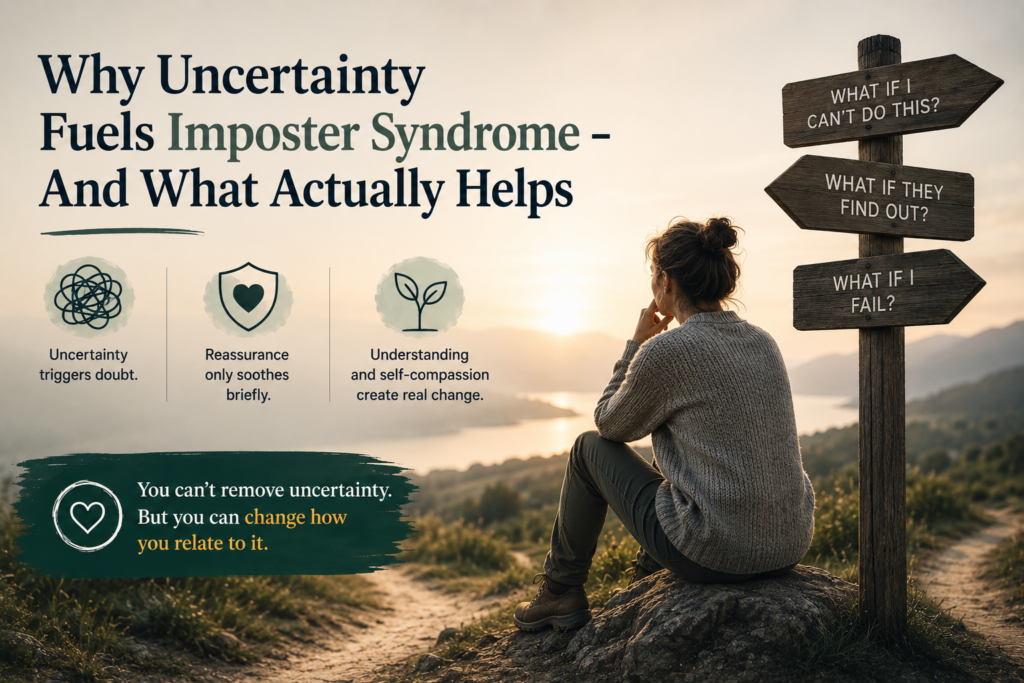
Most people think of imposter syndrome primarily as a confidence problem - a deficit of self-belief that more evidence, more experience, or more reassurance might eventually fix. But in practice, what tends to sit at the heart of it isn't really about confidence at all. It's about uncertainty.
Not uncertainty in the abstract sense, but the very specific, visceral discomfort of not knowing - how things will go, how you'll be judged, whether what you've done is good enough, and more than that, the way that discomfort gets treated as a threat that must be escaped rather than a feeling that can simply be tolerated.
Understanding this distinction tends to change something for people. Because if the problem is really about uncertainty, the solution isn't more evidence. It's a different relationship with not knowing.
Why uncertainty feels so threatening
Uncertainty is part of every working day. You send an email and don't know how it will land. You present an idea and can't predict the response. You take on a new responsibility without being sure yet that you can handle it. Most people navigate this background hum of not-knowing without too much difficulty.
But for people with imposter syndrome, uncertainty in certain domains - competence, credibility, how others are judging you - doesn't feel like background noise. It feels dangerous. The not-knowing isn't just uncomfortable; it registers as something that needs to be resolved, urgently, before you can settle.
Psychologists Reid Wilson and Lynn Lyons put it clearly: anxiety wants two things - certainty that everything will be okay, and comfort, the feeling of being safe right now. Imposter syndrome is, in many ways, the mind's attempt to secure both of those things in a world that can't reliably provide either.
The threat system - the part of the brain designed to detect and respond to danger - doesn't distinguish well between physical threats and social ones. The fear of being found out, judged as inadequate, or exposed as less capable than people believed registers in the nervous system as genuine danger, and when danger is perceived, the system responds: do something, fix it, make it safe.
How the attempts to fix uncertainty keep it going
The strategies people use to manage uncertainty-driven imposter syndrome are almost always understandable, often temporarily effective, and consistently counterproductive in the long run. They're worth naming clearly because they're so easy to mistake for sensible precautions.
Worry is one of the most common. It feels like preparation - like you're being thorough, covering the angles, thinking things through. But worry is really an attempt to think your way out of not knowing, and it doesn't work. Uncertainty can't be resolved by thinking about it more carefully. It can only be resolved by time - and by that point, the worry has generated its own anxiety that still needs managing.
Reassurance-seeking follows a similar pattern. Asking whether the work is okay, whether the email sounded right, whether people thought the presentation went well - each of these brings brief relief, and then the need returns, usually stronger. The more you rely on external confirmation to feel settled, the less your own judgement develops as a source of stability. Confidence stays fragile and externally dependent.
Over-preparing is the most socially acceptable form of uncertainty management and therefore the easiest to miss. Working beyond what the task actually requires, checking and rechecking, covering every possible angle - all of it feels responsible. But it confirms, quietly, that the situation is too threatening to approach with ordinary competence. The relief it provides is real. The cost - in time, exhaustion, and reinforced self-doubt - accumulates steadily.
Avoidance is perhaps the most costly of all. Turning down opportunities, staying quiet when you have something to contribute, holding back from anything that feels too visible or too risky - these choices keep imposter syndrome intact by preventing exactly the experiences that would begin to challenge it. The situations you avoid never get the chance to go well.
What all of these strategies share is a simple common function: they are attempts to escape the discomfort of uncertainty. And each time they succeed - even briefly - the brain learns that the discomfort was something that needed to be escaped. The intolerance grows rather than easing.
A different way of responding
The goal, then, isn't to eliminate uncertainty - that's neither possible nor necessary. It's to change your relationship with the discomfort that uncertainty brings. To develop the capacity to feel the not-knowing without automatically treating it as a threat that demands an immediate response.
This is slower work than it sounds, and it's not something that happens through deciding to stop worrying or telling yourself to just trust the process. The urge to seek certainty is driven by the nervous system, not by logic, and it needs to be worked with at that level.
In practice it begins with awareness - noticing when the uncertainty-driven urge appears. What situation triggered it? What specifically does the mind say is at risk? What does the body feel? This kind of observation, done without self-criticism, starts to create a small but real gap between the urge and the automatic response to it.
From there, the work involves gradually learning to sit with the discomfort for a little longer before acting on it. Not checking the email quite so many times. Not asking for reassurance quite so quickly. Discovering - incrementally, through experience rather than reasoning - that the uncertainty was survivable. That the discomfort passed without the feared outcome materialising. This is how tolerance for uncertainty actually builds: not through insight, but through repeated experience of the discomfort not being as catastrophic as the threat system predicted.
Values-led action is an important part of this. When the question shifts from how can I make this feel safer? to what would I do here if I weren't letting anxiety make the decision? - behaviour starts to be organised around what matters rather than what threatens. That shift, sustained over time, is what gradually builds the kind of confidence that doesn't depend on certainty being available first.
What this looks like in therapy
Therapy for uncertainty-driven imposter syndrome works at several levels simultaneously. Building awareness of the patterns - seeing clearly how the cycle operates and what maintains it - gives the work a foundation. Understanding where the intolerance of uncertainty came from, and why the nervous system learned to treat ambiguity as threat, tends to reduce the shame and self-criticism that usually accompany the pattern.
Skills drawn from ACT help create distance from the thoughts that make uncertainty feel unbearable - noticing I might be found out as a thought rather than a fact, and choosing how to respond to it rather than automatically obeying it. Grounding techniques regulate the physical anxiety that drives the urge to seek certainty. And gradually, values-based action starts to replace fear-based action - not because the uncertainty disappears, but because it stops being the deciding factor.
The question that tends to mark the shift is a small but significant one. Instead of how can I be sure this will go well? it becomes how do I move forward even though I don't know how this will turn out? That's not a comfortable question. But it's the one that leads somewhere.
Recognise yourself in any of this?
If uncertainty and self-doubt are keeping you stuck and you'd like to explore what therapy might offer.
I offer a free 15-minute phone consultation - no obligation, just a conversation.